
Introduction
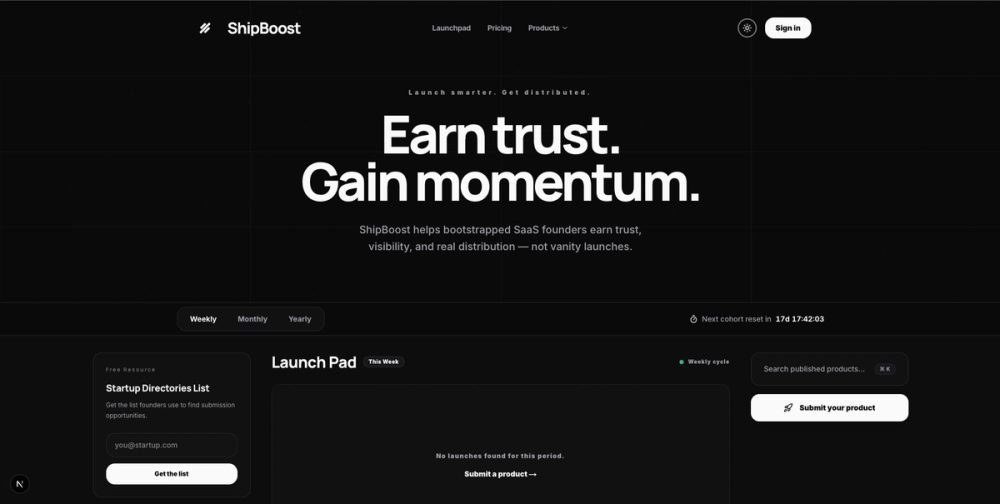
ShipBoost is presented through its public site as ShipBoost | Launch once. Keep getting discovered. | ShipBoost Pricing | Free and Premium Launches | Submit Your SaaS Product | ShipBoost | Support Tools for SaaS Founders | ShipBoost | ShipBoost helps bootstrapped SaaS founders turn a launch into long-tail distribution with weekly launch boards, clean public listings, and discovery paths that outlive launch day. | Compare Free Launch, Premium Launch, and ShipBoost's partner submission support before the opening cohort. | Submit your SaaS product to ShipBoost, choose a Free Launch or Premium Launch path, and turn launch into ongoing distribution. | Discover the support tools on ShipBoost. Compare curated products, featured listings, and buyer-friendly options. | Categories | Explore | Launch once. Keep getting discovered.. The clearest reader value is the ability to understand the product's visible positioning from the homepage and decide whether it fits a practical evaluation need. A careful buyer or user should review ShipBoost directly and verify unclear details such as pricing, support, technical limits, and data sources before depending on it.
Key Features
- ShipBoost helps bootstrapped SaaS founders turn a launch into long-tail distribution with weekly launch boards, clean public listings, and discovery paths that outlive launch day. | Compare Free Launch, Premium.
- Categories
- Launch once. Keep getting discovered.
- Founder resource
- Launch Pad
- First launch week starts soon.
Use Cases
ShipBoost appears useful for readers who need a quick way to evaluate a ai tool option and decide whether the public offer matches their workflow. The visible page copy gives enough context for an initial review, but it should not replace product testing or direct confirmation of operational details.
For teams comparing tools, ShipBoost can be added to a shortlist when its visible positioning matches the problem they are trying to solve. A practical evaluation should start with the main public claims, then confirm whether the product supports the exact use case, team size, region, language, or technical environment required.
The available site signals suggest a ai tool context, so use cases should stay close to that category rather than assuming unrelated workflows. If the product will be used in a professional or client-facing setting, readers should verify reliability expectations, support routes, and any limits that are not described on the homepage.
Pricing
The public page includes pricing-related signals: Launchpad Pricing Products Categories Marketing Sales Support Development Finance Operations View all categories → Explore Tags Submit your product Launchpad Pricing Products Marketing Sales Support Development Finance Operations All categories Tags Submit your product Sign in Founder-first launch distribution Launch once. Keep getting discovered. ShipBoost helps bootstrapped SaaS founders turn a launch into ongoing distribution with weekly launch boards, founder-ready listings, and long-tail discovery pages. Submit your product Sign in Founder-first launch distribution Launch once. Keep getting discovered. ShipBoost helps bootstrapped SaaS founders turn a launch into ongoing distribution with weekly launch boards, founder-ready listings, and long-tail discovery pages. Submit your product Founder resource Search 336+ startup directories in one place. Get the hosted ShipBoost resource and work through founder distribution research faster. Get the directory list 336+ directories and launch sites. Access link sent by email. Submit your product Launch Pad This Week Weekly cycle Launchpad opens May 4 First launch week starts soon. Submissions are open now. Approved products will appear here when the first weekly launch board begins. 00 Days 00 Hours 00 Mins 00 Secs Submit before opening week TOP 1 WINNER Weekly prize #1 First winner coming soon The top product from the completed weekly board will be featured here during the next launch cycle. Founder resource Search 336+ startup directories in one place. Get the hosted ShipBoost resource and work through founder distribution research faster. Get the directory list 336+ directories and launch sites. Access link sent by email. Why ShipBoost Most launch sites give you a spike. Most directories give you a dead listing. ShipBoost is built to do both jobs better: launch visibility now, and discoverability after the launch window ends. Daily launch feeds Fast visibility, but strong products can get buried in a one-day reset before the right buyers ever see them. Generic directories Permanent listings help, but many become low-signal storage with weak context and weak discovery paths. ShipBoost Weekly launch visibility, cleaner public listings, and discovery surfaces that keep working through categories and alternatives. Founder outcomes What founders get after launch ShipBoost is designed to help founders do more than chase a short-lived spike. A launch becomes a public asset: something buyers can discover, compare, and come back to after the launch week rotates. For founders, that means clearer launch placement, a stronger public listing, and discovery paths that keep working after the initial launch window ends. Weekly board visibility Launch into a cleaner weekly surface where products are easier to compare and less likely to disappear overnight. Permanent public listing Give your SaaS a founder-ready listing that stays useful after launch day instead of becoming dead archive furniture. Long-tail discovery Keep showing up through categories, tags, and alternatives pages when the right buyer is still searching later. See the system The surfaces already doing the work Even before ShipBoost has mature traffic proof, the product already has real surfaces founders can use and buyers can browse. That matters more than abstract positioning on its own. LIVE Weekly board Launch visibility in a cleaner cohort-based surface. LIVE Categories Discovery paths for buyers browsing by workflow and use case. LIVE Alternatives Comparison-driven pages built for higher-intent discovery. LIVE Directories resource A practical founder wedge tied directly to distribution planning. LIVE Launch workflow A clear path from submission to listing to launch timing. Want to launch here? Start with the submission flow if your product is ready. If you are still deciding, compare the launch options or browse the startup directories resource first. Submit your product See launch pricing Browse the startup directories resource SPONSOR SLOT Advertise here Promote your product SPONSOR SLOT Advertise here Promote your product SPONSOR SLOT Advertise here Promote your product TOP 1 WINNER Coming soon Last week's top product will be featured here. ShipBoost ShipBoost helps bootstrapped SaaS founders earn trust, visibility, and real distribution - not vanity launches. Categories Launchpad Pricing Products Categories Marketing Sales Support Development Finance Operations View all categories → Explore Tags Submit your product Launchpad Pricing Products Marketing Sales Support Development Finance Operations All categories Tags Submit your product Sign in Pricing Readers should still verify current plan limits, renewal terms, account requirements, and whether any usage-based restrictions apply before committing.
User Experience and Support
The public page is scan-friendly enough for a first-pass review because it exposes the product name, page title, headings, and short descriptive copy. That is useful for visitors who want to understand the basic promise before investing time in deeper evaluation.
Support-related signals are visible on the site: Launchpad Pricing Products Categories Marketing Sales Support Development Finance Operations View all categories → Explore Tags Submit your product Launchpad Pricing Products Marketing Sales Support Development Finance Operations All categories Tags Submit your product Sign in Founder-first launch distribution Launch once. Keep getting discovered. ShipBoost helps bootstrapped SaaS founders turn a launch into ongoing distribution with weekly launch boards, founder-ready listings, and long-tail discovery pages. 336+ directories and launch sites. Access link sent by email. Products Categories Marketing Sales Support Development Finance Operations View all categories → Explore Tags Submit your product Evaluators should still confirm response channels, documentation depth, and onboarding help for their own use case.
Technical Details
Technical signals visible on the public page include: Discovery paths for buyers browsing by workflow and use case. Submit your product Sign in Founder-first launch distribution Launch once. Keep getting discovered. ShipBoost helps bootstrapped SaaS founders turn a launch into ongoing distribution with weekly launch boards, founder-ready listings, and long-tail discovery pages. Submit your product Founder resource Search 336+ startup directories in one place. Get the hosted ShipBoost resource and work through founder distribution research faster. Get the directory list 336+ directories and launch sites. Access link sent by email. Submit your product Launch Pad This Week Weekly cycle Launchpad opens May 4 First launch week starts soon. Submissions are open now. Approved products will appear here when the first weekly launch board begins. 00 Days 00 Hours 00 Mins 00 Secs Submit before opening week TOP 1 WINNER Weekly prize #1 First winner coming soon The top product from the completed weekly board will be featured here during the next launch cycle. Founder resource Search 336+ startup directories in one place. Get the hosted ShipBoost resource and work through founder distribution research faster. Get the directory list 336+ directories and launch sites. Access link sent by email. Why ShipBoost Most launch sites give you a spike. Most directories give you a dead listing. ShipBoost is built to do both jobs better: launch visibility now, and discoverability after the launch window ends. Daily launch feeds Fast visibility, but strong products can get buried in a one-day reset before the right buyers ever see them. Generic directories Permanent listings help, but many become low-signal storage with weak context and weak discovery paths. ShipBoost Weekly launch visibility, cleaner public listings, and discovery surfaces that keep working through categories and alternatives. Founder outcomes What founders get after launch ShipBoost is designed to help founders do more than chase a short-lived spike. A launch becomes a public asset: something buyers can discover, compare, and come back to after the launch week rotates. For founders, that means clearer launch placement, a stronger public listing, and discovery paths that keep working after the initial launch window ends. Weekly board visibility Launch into a cleaner weekly surface where products are easier to compare and less likely to disappear overnight. Permanent public listing Give your SaaS a founder-ready listing that stays useful after launch day instead of becoming dead archive furniture. Long-tail discovery Keep showing up through categories, tags, and alternatives pages when the right buyer is still searching later. See the system The surfaces already doing the work Even before ShipBoost has mature traffic proof, the product already has real surfaces founders can use and buyers can browse. That matters more than abstract positioning on its own. LIVE Weekly board Launch visibility in a cleaner cohort-based surface. LIVE Categories Discovery paths for buyers browsing by workflow and use case. LIVE Alternatives Comparison-driven pages built for higher-intent discovery. LIVE Directories resource A practical founder wedge tied directly to distribution planning. LIVE Launch workflow A clear path from submission to listing to launch timing. Want to launch here? Start with the submission flow if your product is ready. If you are still deciding, compare the launch options or browse the startup directories resource first. Submit your product See launch pricing Browse the startup directories resource SPONSOR SLOT Advertise here Promote your product SPONSOR SLOT Advertise here Promote your product SPONSOR SLOT Advertise here Promote your product TOP 1 WINNER Coming soon Last week's top product will be featured here. ShipBoost ShipBoost helps bootstrapped SaaS founders earn trust, visibility, and real distribution - not vanity launches. Categories You need an account to submit to ShipBoost. That keeps your draft, listing, and launch status tied to one founder workflow from submission through launch. Submit your product Sign in Submit your product Turn your launch into a cleaner public listing, weekly board visibility, and discovery that can keep working after launch day. Weekly launch board placement Founder-ready public listing Category and alternatives discovery over time Dashboard control over your launch and listing Prelaunch Mode ShipBoost opens on May 4, 2026 UTC. Submit now to line up your launch before the public opening. You need an account to submit to ShipBoost. That keeps your draft, listing, and launch status tied to one founder workflow from submission through launch. Save your draft anytime and come back later. You do not need to finish everything in one session. Create an account Log in ShipBoost ShipBoost helps bootstrapped SaaS founders earn trust, visibility, and real distribution - not vanity launches. Categories The page also references HubSpot. The site does not fully explain implementation details, data sources, or operational limits, so technical evaluators should verify those points directly.
Pros and Cons
Pros
- The public page gives enough information to identify the product's broad purpose.
- The homepage can serve as a simple starting point for evaluation.
- Visible headings and descriptive copy help readers understand the product context quickly.
- The product can be assessed from public materials before a deeper trial.
Cons
- Pricing and plan boundaries may need direct verification.
- Support and documentation routes are not always clear from the visible page copy.
- Technical depth, integrations, and operational limits may require further checking.
- The page should not be treated as proof of performance, reliability, or outcomes without additional validation.
FAQ
What is ShipBoost?
ShipBoost is presented on its public website as ShipBoost | Launch once. Keep getting discovered. | ShipBoost Pricing | Free and Premium Launches | Submit Your SaaS Product | ShipBoost | Support Tools for SaaS Founders | ShipBoost. The page describes it as: ShipBoost helps bootstrapped SaaS founders turn a launch into long-tail distribution with weekly launch boards, clean public listings, and discovery paths that outlive launch day. | Compare Free Launch, Premium Launch, and ShipBoost's partner submission support before the opening cohort. | Submit your SaaS product to ShipBoost, choose a Free Launch or Premium Launch path, and turn launch into ongoing distribution. | Discover the support tools on ShipBoost. Compare curated products, featured listings, and buyer-friendly options.
Who is ShipBoost suited for?
It appears suited for users or teams evaluating tools in the ai tool category. The right fit depends on the reader's workflow, expected feature depth, budget, and need for support or integrations.
What can users verify from the public page?
Users can verify the product name, homepage, title, visible headings, and the descriptive claims shown on the site. Visible headings include Categories, Explore, Launch once. Keep getting discovered., Founder resource.
Does ShipBoost publish pricing information?
The page includes some pricing-related language, but readers should confirm current plans and restrictions before purchasing or adopting it.
What support or documentation should buyers look for?
Buyers should look for help docs, onboarding material, contact options, tutorials, and troubleshooting guidance. These details matter if ShipBoost will be used regularly rather than tested once.
What technical questions should evaluators ask?
Evaluators should ask whether ShipBoost supports the platforms, integrations, exports, APIs, data sources, and operational limits they need. The visible page copy should be treated as a starting point, not a complete technical specification.
What is the main limitation of evaluating ShipBoost from the public page?
The main limitation is that public homepage copy rarely explains every practical detail. Readers should verify pricing, support, technical constraints, update frequency, and real workflow fit before relying on the product.
Conclusion
ShipBoost is worth reviewing when its public positioning matches the problem a reader is trying to solve. The page provides a useful starting point, but the stronger evaluation comes from checking current pricing, support, technical details, and workflow fit on the official site before making a decision.