
Introduction
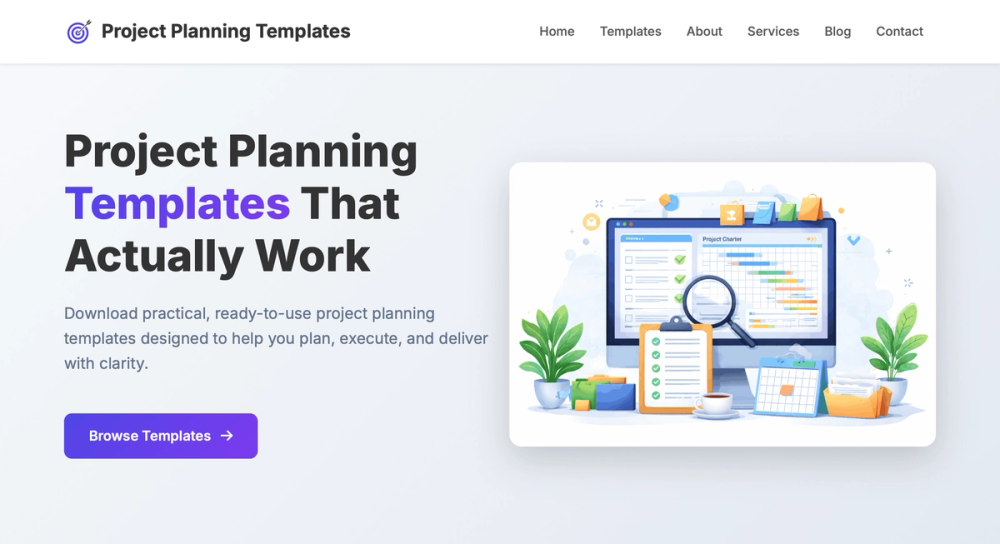
Project Planning Templates is a resource site offering practical, ready-to-use project management documents for teams that need clearer planning, execution, and delivery habits. The public pages position it for project managers, startup founders, consultants, and software teams that want structured documentation without building every template from scratch.
The site's strongest signal is its focus on usable planning artifacts rather than theory alone. It also connects the templates to technical project management, Agile support, stakeholder alignment, and delivery advisory, which makes it especially relevant for software and startup environments.
Key Features
- Ready-to-use project planning templates that users can copy, customize, and apply immediately.
- Coverage across planning documents such as project charters, project briefs, project intake forms, project summaries, project plans, scopes of work, and product requirements documents.
- A practical focus on defining scope, stakeholders, objectives, deliverables, and technical expectations early in the project lifecycle.
- Template categories designed to support planning, execution, documentation standards, and stakeholder alignment.
- Background context from a Technical Project Manager working with startups, Agile practices, software delivery, and execution support.
- A contact path for teams that want to discuss technical project management, Agile support, or delivery advisory.
Use Cases
Project Planning Templates fits teams that need a clearer starting point for new projects. A startup founder or project manager can use a project charter, brief, or intake form to clarify objectives, stakeholders, scope, and expectations before work begins.
The site also appears useful for software teams that need stronger delivery documentation. Product requirements documents, scopes of work, and project plans can help align engineering, product, clients, and stakeholders around what is being built and how delivery will be managed.
For growing teams, the advisory angle matters. The public pages describe support for Agile execution, risk and dependency tracking, sprint planning, retrospectives, workflow improvement, and technical leadership, so the resource is not limited to static documents. It may also serve teams looking for practical delivery structure.
Pricing
The visible pages emphasize downloading practical project planning templates, but they do not clearly show a detailed pricing table, paid plan, subscription, or checkout terms in the fetched evidence. Users should check the live template pages to confirm whether each document is free, paid, downloadable after signup, or part of a larger service offering.
User Experience and Support
The site is organized around a simple template library and supporting pages such as About and Contact. Navigation points to template types including Project Charter, Project Brief, Project Intake Form, Project Summary, Project Plan, Scope of Work, and Product Requirements Document, which makes the browsing experience practical for users who already know the document they need.
Support is presented mainly through the Contact page and the consulting-oriented language around technical project management, Agile support, and delivery advisory. The fetched evidence does not show a help center, ticketing system, or live chat, so users who need direct assistance should use the contact route and clarify response expectations.
Technical Details
Project Planning Templates is a web-based resource for project documentation rather than a software platform with visible APIs, integrations, or account-based workflow automation. The available evidence does not describe a technical stack, SDK, export integrations, or collaboration features.
The technical relevance is in the content itself. Templates such as PRDs, scopes of work, project plans, and intake forms are especially useful in software delivery because they help define requirements, dependencies, risks, scope, and stakeholder expectations before implementation begins.
Pros and Cons
Pros
- Practical document types map closely to real project planning needs.
- The site connects templates with software delivery, Agile execution, and startup project management rather than presenting generic business forms.
- Contact and advisory signals give teams a route to discuss broader delivery support.
- The template library can reduce the blank-page problem for teams that need project structure quickly.
Cons
- Pricing and access terms are not fully clear from the fetched evidence.
- The site does not visibly describe collaboration, automation, or integration features, so users should not assume it works like a project management app.
- Support appears contact-based rather than a formal help center or documented onboarding flow.
- Teams with highly regulated or complex delivery processes may need to customize templates heavily before use.
FAQ
What is Project Planning Templates?
Project Planning Templates is a website offering ready-to-use project management templates for planning, executing, and delivering projects with more clarity. The visible pages focus strongly on software delivery, Agile support, documentation, and stakeholder alignment.
Who is Project Planning Templates designed for?
It is designed for project managers, startup founders, consultants, product teams, and software delivery teams that need structured planning documents. It may be useful for teams that want practical templates rather than abstract project management advice.
What kinds of templates are visible on the site?
The site navigation includes Project Charter, Project Brief, Project Intake Form, Project Summary, Project Plan, Scope of Work, and Product Requirements Document. These documents support early planning, scope definition, requirements alignment, and delivery communication.
Does Project Planning Templates show pricing?
The fetched evidence does not show a clear pricing table or subscription model. Users should check the individual template pages or contact the site owner to confirm whether templates are free, paid, or tied to a consulting service.
Does the site offer consulting or advisory support?
The public pages mention technical project management, Agile support, delivery advisory, sprint planning, retrospectives, risk and dependency tracking, and workflow improvement. Teams interested in services should use the Contact page to confirm scope, availability, and terms.
Is Project Planning Templates a project management software app?
The visible evidence presents it as a template and advisory resource, not as a full project management software platform. It does not clearly describe dashboards, task tracking, integrations, APIs, or team collaboration features.
What should teams verify before using a template?
Teams should confirm whether the template fits their project type, delivery process, stakeholder expectations, and legal or contractual needs. For technical projects, they should also adapt requirements, dependencies, acceptance criteria, and ownership details to their actual workflow.
Conclusion
Project Planning Templates is a practical resource for teams that want clearer project documentation and stronger delivery structure. Its value is clearest for software teams, startup operators, and project managers who need reusable documents for planning and alignment.
The site should be treated as a starting point, not a substitute for project judgment. Teams will get the most from it by choosing the right template, tailoring it to their workflow, and verifying pricing or advisory terms directly on the live site.