
Introduction
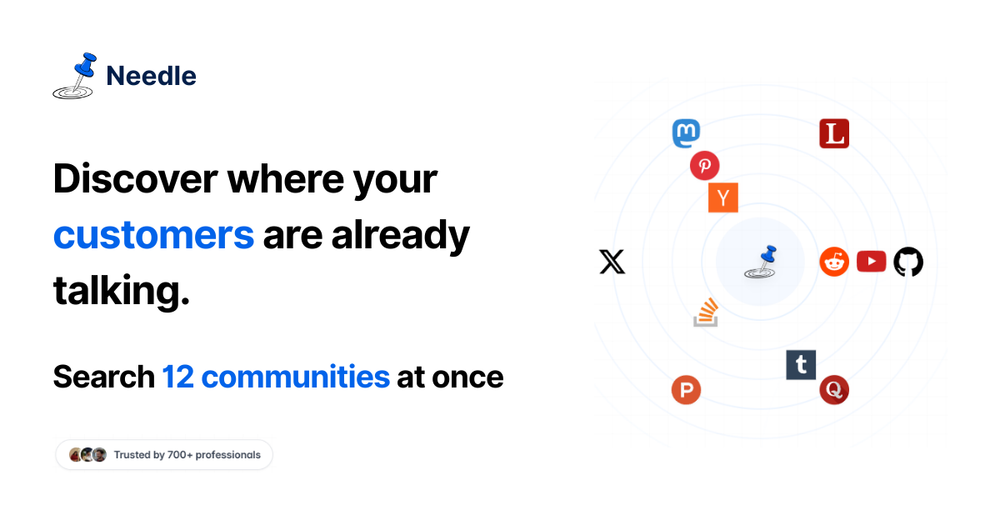
Needle is a conversation intelligence platform for customer discovery, competitor tracking, keyword monitoring, and early market research. The public site positions it around searching discussions across 13 communities, including Reddit, Hacker News, GitHub, Twitter/X, and Bluesky, so founders and product teams can find market signals from real conversations. Its clearest fit is for teams that need faster research inputs, while careful users should still verify data coverage, plan limits, and how intent ranking works for their specific market.
Key Features
- Search across 13 online communities from one product interface, with the site naming Reddit, Hacker News, GitHub, Twitter/X, Bluesky, and more.
- Customer discovery workflows for finding people discussing alternatives to competitors or expressing problems that a product might solve.
- Competitor tracking and keyword monitoring for keeping up with market conversations over time.
- Weekly market pulse positioning, giving users a recurring way to review relevant signals rather than running only one-off searches.
- API-based collection from supported platforms, followed by filtering and ranking by relevance and intent.
- Product demos, FAQ content, pricing navigation, and a related directory of verified startups and tools.
Use Cases
Needle is most directly aimed at founders and product teams looking for customer discovery signals outside surveys and sales calls. The site's example query, "alternatives to Notion," shows how a user might identify people comparing tools, describing frustrations, or looking for a replacement in public discussions.
It also appears useful for competitor and category monitoring. A team could track competitor names, product categories, or problem phrases to understand what users are already asking for across communities. That kind of workflow can support idea validation, messaging research, and early sales outreach, provided the team reviews the original conversations rather than treating ranked results as final conclusions.
The product may be especially relevant when speed matters. Needle's public copy claims users can search platforms and get a market pulse in minutes, but teams should verify whether their niche has enough public discussion volume across the supported sources.
Pricing
Needle has a dedicated pricing page, and the public copy says users can try Needle free. The fetched evidence does not expose the full plan table, seat limits, query limits, billing cycle, or feature differences between plans. Before using Needle for recurring research, buyers should confirm what each plan includes, how many searches or monitored terms are allowed, and whether historical data access varies by tier.
User Experience and Support
Needle's site presents a straightforward path for evaluation: users can read the FAQ, visit pricing, review product demos, and try the product free. The availability of product demos is useful because conversation intelligence tools are easier to judge when users can see search results, filtering behavior, and workflow screenshots.
Support signals include a FAQ page, contact link, privacy policy, and terms of service. The visible evidence does not show live chat, onboarding services, implementation support, or detailed documentation, so teams with compliance, data-source, or procurement requirements should check those details directly before adopting it broadly.
Technical Details
Needle says it searches 13 platforms via their APIs and then filters and ranks results by relevance and intent. This is an important technical distinction because the product is not described as a generic web scraper; its public positioning emphasizes supported community sources and API-based access.
The site names Reddit, Hacker News, GitHub, Twitter/X, and Bluesky among the covered communities. It does not show API documentation for customers, export formats, integration setup, data retention rules, or details about how ranking is calculated. For teams planning to operationalize Needle inside a research or sales workflow, those are the technical details to verify.
Pros and Cons
Pros
- Clear product identity around conversation intelligence, customer discovery, competitor tracking, and keyword monitoring.
- Multi-community search can reduce the need to manually check separate platforms for early market signals.
- The public page gives concrete use cases, including finding people discussing alternatives to competitors and validating startup ideas.
- API-based source coverage and intent ranking are useful signals for teams that need more than raw keyword matching.
Cons
- The full pricing table and plan limits are not visible in the fetched evidence, even though a pricing page exists.
- Data quality will likely depend on whether the target market is actively discussed on Needle's supported platforms.
- Ranking by relevance and intent is described publicly, but the criteria are not explained in enough detail to evaluate edge cases.
- Support and documentation details appear limited from the visible public copy, so larger teams may need additional clarification.
FAQ
What is Needle used for?
Needle is used for conversation intelligence and market research. Its public site says users can search discussions across 13 communities to discover customers, track competitors, monitor keywords, and spot emerging problems.
Who is Needle suited for?
Needle appears suited for founders, product marketers, indie builders, and research-oriented teams that want to find customer pain points in public conversations. It is especially relevant when a team wants to validate ideas or monitor competitor mentions across multiple communities.
Which communities does Needle search?
The public site names Reddit, Hacker News, GitHub, Twitter/X, Bluesky, and more as part of its 13-community coverage. Users should confirm the current source list and any platform-specific coverage limits before relying on it for a niche market.
How does Needle rank results?
Needle says it searches supported platforms via their APIs, then filters and ranks results by relevance and intent. The visible page does not explain the ranking formula, so users should review result examples and demos to decide whether the prioritization fits their research needs.
Can Needle help find competitor alternatives discussions?
Yes, the public page gives "alternatives to Notion" as an example search for finding people comparing tools. That suggests Needle can support competitor-alternative research, but users should still inspect the underlying conversations before taking action.
Does Needle show pricing publicly?
Needle links to a pricing page and says users can try the product free. The fetched evidence does not include the full plan details, so buyers should check plan limits, billing terms, monitored keyword allowances, and whether premium features are separated by tier.
What should teams verify before using Needle for market research?
Teams should verify the supported community list, source freshness, ranking behavior, export options, plan limits, and whether their target audience is active on the covered platforms. These details determine whether Needle can provide enough reliable signal for a specific category.
Conclusion
Needle gives founders and product teams a focused way to search real community conversations for customer discovery and market monitoring. Its public page is strongest around the promise of multi-source search, competitor tracking, keyword monitoring, and relevance-based filtering. Before making it part of a recurring research workflow, users should review pricing, source coverage, result quality, and technical limits directly in the product.