
Introduction
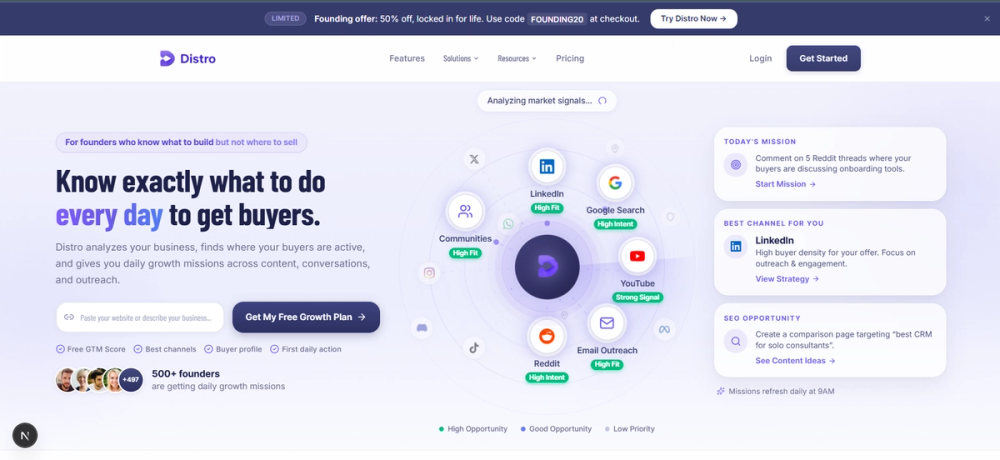
Distro markets itself as a daily growth execution system for founders who want clear actions instead of another static strategy document. The public site describes analyzing a business, surfacing where buyers are active, and delivering daily missions across content, conversations, and outreach. Teams evaluating the product should confirm plan limits, channel coverage, and whether stated outcomes match their stage before committing budget.
Key Features
- Business intake from a website URL or short description, followed by a growth plan with score, gaps, channels, buyer profiles, and recommended paths to customers.
- Three daily missions with task breakdowns spanning content, SEO, ads, outreach, communities, and follow-up, plus streak and progress tracking.
- GTM intelligence outputs such as ICP-style profiles, buyer search links, and channel-specific strategies across 20+ named channels including LinkedIn, Reddit, Google, Meta, TikTok, YouTube, email, and WhatsApp.
- SEO and content engine with keyword strategy, Mon/Wed/Fri content planning, full article generation on higher tiers, and AI citation optimization mentioned in feature lists.
- Ad campaign builder with recommendations and creative briefs for Meta, Google, and TikTok, plus community mapping and advanced outreach prompts on paid plans.
- Vertical landing paths for B2B SaaS, ecommerce, real estate, local services, mobile apps, and coaches, each framing daily missions for that business type.
Use Cases
Early-stage founders who feel spread across too many channels may use Distro to narrow focus into a small set of daily actions tied to a generated plan. The site contrasts "strategy doc and dashboard" tools with morning missions meant to be executed in roughly 15-30 minutes per block.
B2B SaaS operators see positioning around LinkedIn, outbound, SEO content, and retargeting, with example weekly missions such as commenting on ICP posts, connection requests, publishing pillar content, and launching search campaigns. Ecommerce and real estate pages describe parallel daily rhythms for ads, content, retargeting, and lead follow-up.
Agencies or operators managing multiple lines might look at the Scale plan's unlimited business tracking, faster AI generation, and data export, though fit depends on how much automation versus human execution they expect.
Pricing
The pricing page messaging on the fetched pages highlights plans starting from about $49 per month, a Founding20 checkout code described as locked in for life, and cancel-anytime billing with access through the end of the paid period. Starter-style copy lists one business tracked, three daily missions with five tasks each, GTM report, SEO/content engine, ad builder, community mapping, and email accountability. Scale adds unlimited businesses, priority AI generation, fuller content and outreach outputs, weekly recap emails, export, and direct founder support via X. Exact current dollar amounts and feature gates should be verified at checkout because multiple plan names appear across long combined pages.
User Experience and Support
The homepage flow emphasizes "Get My Free Growth Plan," sample mission cards, and comparisons between generic tools and Distro's daily execution framing. In-app help, email reminders three times daily, and direct founder support on Scale are listed in comparison tables.
Free resources on the site include guides, a marketing plan generator, glossary, blog, and comparison content versus agencies or fractional CMO positioning. Evaluators should confirm onboarding depth and support response expectations for their plan tier.
Technical Details
Distro is presented as a web-based marketing operations layer rather than a CRM or ad platform replacement. Integrations are described at the channel level (LinkedIn, ad platforms, email, WhatsApp) without API documentation in the extracted copy. AI generation powers plans, content, outreach prompts, and citation-related tooling per marketing lists.
Data export is listed on Scale. Technical buyers should verify what can be exported, whether outreach automation connects to external tools, and how ad builders relate to live campaign deployment in ad accounts.
Pros and Cons
Pros
- Strong focus on daily, time-boxed missions instead of open-ended strategy work.
- Broad channel and vertical coverage on marketing pages suits heterogeneous founder businesses.
- Transparent cancel-anytime language and side-by-side plan comparison on fetched pricing content.
- Free growth plan entry point lowers the barrier to seeing channel recommendations before subscribing.
Cons
- Aggressive growth statistics and pipeline improvement figures on the site are marketing claims, not independently verified results.
- Heavy page bundling can make it harder to see which features apply to a specific vertical without reading multiple sections.
- Execution still depends on founder time; the tool does not replace channel accounts or compliance review for ads and outreach.
- Multi-business and export capabilities appear tied to higher tiers, which may limit smaller teams on entry plans.
FAQ
What is Distro based on the public website?
Distro is described as a system that analyzes your business, identifies where buyers are active, and assigns daily growth missions across content, conversations, and outreach so founders know what to do each day.
Who does Distro seem built for?
Marketing copy targets founders and teams across SaaS, AI products, services, ecommerce, real estate, local services, mobile apps, and coaching businesses, with separate solution pages for several of those segments.
How does the free growth plan differ from paid plans?
The site promotes a free growth plan with score, channels, buyer profile, and first daily actions, while paid plans add ongoing mission tracking, content and ad builders, accountability emails, and expanded generation limits depending on tier.
What channels does Distro mention supporting?
Public lists include LinkedIn, Reddit, Google search and ads, Meta, TikTok, YouTube, email, WhatsApp, Twitter, Hacker News, Product Hunt, and additional channels grouped as "+10 more" for 20+ total.
What do daily missions look like in practice?
Examples on the site include commenting on Reddit or LinkedIn threads, publishing SEO comparison pages, sending outreach, and launching ad campaigns, often framed as three missions per day with 15-30 minute time blocks.
Can you cancel if the rhythm does not fit your team?
The pricing material states full access from day one, no setup fees, and cancellation anytime from Settings with access continuing through the current billing period.
What should buyers verify before trusting ROI claims?
Pages cite metrics such as mission completion counts, growth reports generated, and average pipeline improvement. Those are product marketing figures; your results will depend on market, offer quality, and consistent execution outside the app.
Conclusion
Distro is worth reviewing if you want a structured daily marketing checklist generated from your business context rather than another static GTM PDF. Visit usedistro.com to run the free growth plan, compare Starter versus Scale features, and test whether the mission style matches how your team actually sells before scaling spend on ads or outreach.